
Astrology vs Astronomy: Is the Divide Really That Simple?
Every so often, someone asks me: “So… do you actually believe in Astrology?” Or I’ll see a rather derogatory meme about it on social media. Sometimes the question comes from genuine curiosity. Other times there’s a raised eyebrow involved, perhaps accompanied by a slightly amused smile.
Either way, I enjoy these conversations when there is curiosity.
In fact, this particular blog began after a recent conversation and several social media posts about the phrase “woo-woo”— that wonderfully vague label often applied to anything sitting outside conventional thinking.
It made me wonder whether we’ve become rather uncomfortable with things we can’t easily prove. I also find myself increasingly aware of a divide in our culture. Some people are comfortable leaving room for mystery and symbolism, including the possibility that everything meaningful may not be measurable. Others feel far more at home with empirical evidence and clear explanations.
I’m all for healthy scepticism. I really love a good debate where someone’s willing to ask challenging questions. Curiosity works both ways, though, and there’s a considerable difference between examining something critically and dismissing it before understanding what it actually is.
And this particular conversation inevitably leads to a bigger question: “Why take Astrology seriously when Astronomy is the real science?”
It’s a fair point.
After all, Astronomy does have the advantage of impressive telescopes and reassuringly complicated equations. Astrology deals with something far less tangible: symbolism and interpretation. Astrology isn’t a science in the modern empirical sense.
Understanding what it is, however, requires us to go a little further back.
What do we mean by an esoteric science?
When Astrologers describe Astrology as an esoteric science, they aren’t using the word science in its modern laboratory sense. The word science comes from the Latin scientia, meaning knowledge or a way of knowing.
Historically, disciplines we now place in very different categories were understood as organised systems of knowledge.
Esoteric refers to traditions concerned with inner or hidden knowledge, often exploring symbolism and the relationship between the visible world and aspects of existence that are less tangible.
In this historical sense, Astrology is a structured body of knowledge developed through study and observation, seeking patterns of meaning rather than physical causation.
And this is the point where I sometimes think modern-day sceptics break one of their own rules of scientific enquiry. They don’t do the research.
Because once we look at the history, the familiar image of Astronomy as the sensible scientific sibling and Astrology as its slightly embarrassing “woo-woo” relative becomes rather less straightforward.
When Astronomy and Astrology shared the same sky
For much of human history, Astronomy and Astrology weren’t sitting on opposite sides of an argument. They share the same roots in humanity’s enduring desire to understand the universe and our place within the larger story of life itself.
To our ancient ancestors, the Planets weren’t simply distant collections of rocks and gases. They were experienced as meaningful and alive, intimately connected with life on Earth.
For thousands of years, people studying the sky were also interpreting its meaning. Ancient Babylonians and Greeks developed sophisticated traditions around the heavens, with similar ideas travelling through Persian and Egyptian cultures. The cosmos became both a compass and a storybook. Babylonian scholars carefully recorded Planetary movements so they could anticipate Eclipses and understand seasonal cycles. Those celestial events were also interpreted for their significance to kings and nations, with their meaning extending into everyday life.
The Greek astrologer-astronomer Claudius Ptolemy later became enormously influential in shaping Western thought about the heavens. In his Tetrabiblos, Ptolemy argued that the stars and Planets did not impose an inescapable fate. They reflected tendencies and conditions that could be understood and worked with. As he wrote: “The Astronomer must investigate the movements of the heavenly bodies, but the Astrologer must consider their effects.”
This worldview also has connections with the Stoic concept of sympatheia — the idea of an interconnected cosmos in which the parts exist in relationship with the whole.
Astrology developed within this kind of understanding, observing celestial patterns and finding their echoes within earthly life.
It’s why Mars became associated with courage and conflict, with heat woven into its symbolism. Venus developed associations with love and beauty. Mercury became connected with communication and learning.
These associations weren’t randomly plucked from the sky. They arose through a symbolic understanding of the universe in which patterns could repeat across different levels of experience. Measurement and meaning lived quite happily alongside one another.
For a very long time, nobody seemed particularly concerned that they needed a divorce.
Then came the Age of Enlightenment
The Age of Enlightenment brought extraordinary gifts. Through reason and increasingly rigorous observation, we gained a far deeper understanding of the physical universe and our place within it. Scientific thinking transformed our understanding of the nature of life. Its contribution to human experience is extraordinary, and practising Astrology gives me no reason whatsoever to pretend otherwise.
Our relationship with knowledge changed too. We became increasingly skilled at asking: “How does this work?” And gradually less inclined to ask: “What might this mean?”
Our ability to measure and explain the universe has grown in leaps and bounds ever since. At the same time, the symbolic and mythic dimensions of the sky gradually faded from mainstream Western thought. The stars increasingly became objects to be observed, while their older role as stories to be contemplated receded from view.
And yet Astrology endured. I believe we may even be seeing a resurgence of interest in it now, alongside a continuing human desire for deeper meaning.
We can, of course, recognise physical relationships between celestial bodies and life on Earth. The most obvious example is the Moon, whose gravity shapes our tides and whose changing appearance has long served humanity as a keeper of time and natural rhythm.
Astrology approaches our relationship with the heavens through another framework. Its language is symbolic, exploring correspondences between Planetary movements and patterns within human experience. Which brings us to something we humans still do remarkably well.

We never stopped being symbolic creatures
For all our modern sophistication, symbolism hasn’t ever disappeared. We exchange wedding rings and light candles for people we love. We treasure objects that belonged to those who came before us. Stories about where we came from become part of how we understand who we are. We make art and create rituals around moments that matter. Their significance cannot be weighed or put beneath a microscope. That doesn’t make them meaningless.
Meaning itself is remarkably difficult to measure. Love has no unit of measurement. Neither does grief, yet both can completely alter the landscape of a human life. Beauty resists empirical proof. Purpose is equally reluctant to submit itself to laboratory conditions. Few people would argue that these experiences cease to matter because science cannot assign them a numerical value.
Astrology belongs far more comfortably within this conversation than it ever will inside a laboratory.
Strangely enough, I was reminded of this while reading a children’s story. I’m currently reading The Chronicles of Narnia to my granddaughter.
As a child, you can simply enjoy the adventure. There’s a wardrobe leading to a magical world, talking animals and a rather terrifying White Witch who has condemned Narnia to an endless winter.
Read the story again as an adult and another layer emerges beneath the snow. The White Witch can represent control or emotional coldness. The endless winter can evoke those periods of human experience when life itself feels frozen. None of this requires C. S. Lewis to scientifically prove the existence of an icy queen capable of controlling the seasons. That rather misses the point.
Stories endure because symbols allow us to approach human experience from another direction. Something can carry profound meaning without requiring us to interpret it literally.
Astrology works within similar territory. Its language happens to be Planetary.
So what is Astrology actually doing?
This is where the distinction between Astronomy and Astrology becomes far more useful than an argument about which one deserves to exist.
True empirical science remains one of humanity’s greatest achievements, and I have enormous respect for what it has helped us discover about the universe.
Astronomy can tell us where a Planet is and how it moves through space. It can calculate extraordinary distances and observe physical processes our ancestors could scarcely have imagined.
Astrology asks: “What might these celestial patterns mean within human experience?”
Take Saturn. Astronomy can tell us that Saturn is a distant Planet, the furthest in our Solar System that can readily be seen with the naked eye. It can describe its orbit and spectacular rings in extraordinary physical detail.
Astrology is interested in what Saturn has come to symbolise across its long history.
Time and limitation are central to that symbolism. Saturn speaks of responsibility and structure, including the boundaries we encounter as we mature.
The suggestion isn’t that Saturn is sitting several hundred million miles away issuing instructions about your life. Thank goodness. Life is complicated enough.
Astrology observes celestial patterns alongside human experience and asks whether meaningful correspondences exist between them.
Astrologer Chris Brennan offers a useful modern definition, describing Astrology as the study of the correlation between celestial movements and earthly events in Hellenistic Astrology: The Study of Fate and Fortune.
That word correlation matters.
It takes us away from the simplistic assumption that Astrology requires a Planet to physically cause an event from millions of miles away. Instead, we observe patterns in the sky and explore whether they meaningfully correspond with themes unfolding here on Earth. That distinction has become increasingly important in my own practice.
Timing, potential and free will
My relationship with Astrology has changed considerably through years of study, including my current training with Nightlight Astrology.
I’m becoming less interested in using Astrology to declare exactly what will happen next.
What fascinates me far more is timing and potential.
For me, a Birth Chart isn’t a sentence handed down by the universe. A Planet doesn’t get to boss you around because it happens to be moving through a particular part of the Zodiac.
Thank goodness for that, too.
A Birth Chart gives us a symbolic map of the sky at a particular moment. As Astrologers, we look at the positions of the Planets and the relationships between them, then explore how those patterns might express themselves within the context of an individual life. And there is always a human being living that life.
Two people can experience the same Astrological Transit very differently because their circumstances and histories differ. Each person also retains the ability to choose how they respond.
Astrology gives us something to explore. We bring our lived experience to the conversation.
Free will sits at the heart of our approach.
This is why I’m increasingly wary of reducing Astrology to prediction. Used too rigidly, prediction can turn a rich symbolic system into a list of pronouncements about what the universe has apparently decided to do to us. The possibilities interest me far more.
As I continue to study, what inspires me is the way Astrology can help people recognise patterns in their lives and navigate periods of change. Sometimes it gives language to something we have sensed without quite being able to articulate it. At its best, Astrology leaves room for reflection.
Perhaps we’re asking the wrong question
So, is Astrology a science like Astronomy? No.
I’m quite comfortable saying that.
They share ancient roots, although they have developed into very different disciplines.
Astronomy investigates the physical universe through empirical science.
Astrology engages symbolically with that same sky.
Astronomy measures. Astrology interprets.
And I believe there’s room for both ways of looking upwards.
Despite all our extraordinary knowledge, humans remain wonderfully symbolic creatures. We still make art and tell stories, searching for significance in what happens to us. Sometimes we stand beneath a night sky and feel something that no equation needs to explain.
Astrology reminds me that our lives unfold within something immeasurably larger than our to-do lists and inboxes. We live within cycles far older than we are, beneath a sky that human beings have watched with wonder since long before anyone thought to divide its study into Astronomy and Astrology.
For me, there is something deeply grounding in remembering that.
And then there’s Pluto in Aquarius…
There’s another reason I find this conversation particularly interesting now.
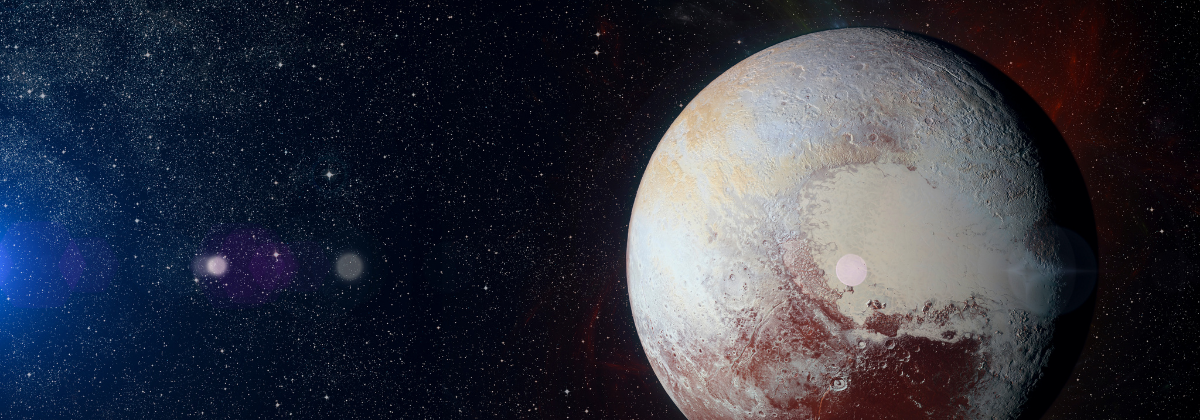
Pluto is moving through Aquarius for approximately the next 20 years and, from an Astrological perspective, I believe this period will keep drawing our attention towards our relationship with knowledge and technology, alongside questions about our place within the collective.
We’re entering an era in which ever more of life can be quantified. Technology can monitor our sleep and count our steps. Algorithms analyse our behaviour, sometimes anticipating what we might want before we’ve consciously decided ourselves. Artificial intelligence can process quantities of information no individual human mind could possibly hold. We’re becoming exceptionally good at measuring ourselves and the world around us.
Which makes me wonder what happens to everything that refuses to fit neatly into the data.
Where does mystery belong in a culture increasingly drawn towards certainty and measurable outcomes? What happens to wonder when we become so preoccupied with explaining the universe that we forget simply to experience some of it?
I don’t see scientific knowledge and symbolic thought as enemies.
Astronomy can continue showing us the astonishing physical reality of the universe.
Astrology can invite us into a relationship with what we see there.
Those are different tasks. Perhaps they always were.
Leaving room for mystery
Which brings me back to the conversation that started all of this.
Perhaps the most interesting question isn’t whether Astrology can win an argument about being “true” or “false.” Perhaps it’s whether modern life has left enough room for mystery.
Evidence matters enormously. So does critical thinking. But I still think wonder deserves a seat at the table.
There’s value in looking up at the night sky and asking: “What is it?”
Then allowing another question to follow: “What might it mean?”
For much of human history, those questions sat comfortably beside one another. Perhaps somewhere along the way we became so accomplished at measuring the universe that we forgot there were other ways of engaging with it.
I’d rather leave a little room for mystery. Room for the stories humanity has carried beneath the stars for thousands of years, and for the possibility that something can hold meaning without first submitting itself for laboratory testing.
Astrology has no need to replace Astronomy or compete with it.
Astronomy measures the heavens. Astrology asks us to contemplate what we see there — and what, perhaps, we recognise reflected back at us.