
Understanding the Moon Cycle: Your Guide to Her 8 Phases
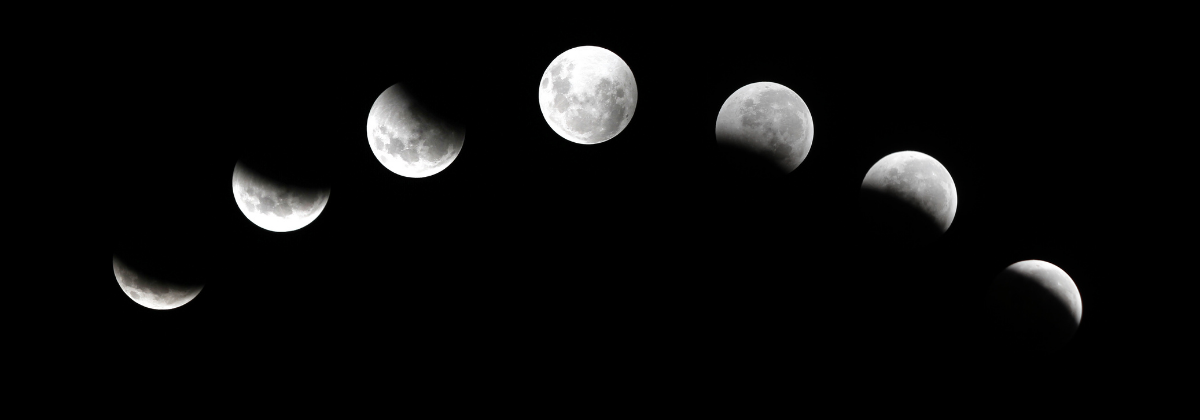
There's a reason we look up. Long before satellites and star charts, people were already tracking the sky, watching one shape dissolve into darkness and slowly rebuild itself into fullness again. That shape is the Moon, and the story it tells every month is the Moon cycle — one of the oldest, most reliable patterns we have access to.
It's easy to think of the Moon as decorative. A pretty light in the sky, occasionally worth a photo. But the Moon cycle isn't just a visual event. It's a working rhythm, one that measured time before calendars existed, and one that Astrology has used for thousands of years to understand our inner tides as closely as it studies the outer sky.
This guide covers what the Moon cycle actually is, how long it lasts, what each Phase means, and how to work with it in a way that's useful rather than mystical for the sake of it.
What is the Moon cycle?
The Moon cycle refers to the complete sequence the Moon moves through as it changes shape in our sky — from the moment it disappears into darkness at the New Moon, through to the point it becomes fully illuminated at the Full Moon, and back to darkness again. This full sequence is properly called the synodic month, and it's the measurement most people mean when they ask about the Moon cycle.
How long is a Moon cycle?
On average, one full cycle of the Moon takes 29.5 days. That number isn't fixed to the day — the Moon's orbit is elliptical, so the exact length can shift by a few hours either way — but 29.5 days is the figure to hold onto if you're tracking the cycle for yourself.
This isn't the same as the time it takes the Moon to physically orbit the Earth, which is closer to 27.3 days. The extra two days in the Moon cycle account for the fact that the Earth is also moving around the Sun, so the Moon has to travel a little further each month to line back up with the Sun from our point of view — which is what actually produces the visual Phases we see. The Moon isn't producing its own light. It's reflecting the Sun's, and the changing angle between the three of them is the entire mechanism behind every Phase.
The 8 Phases of the Moon cycle
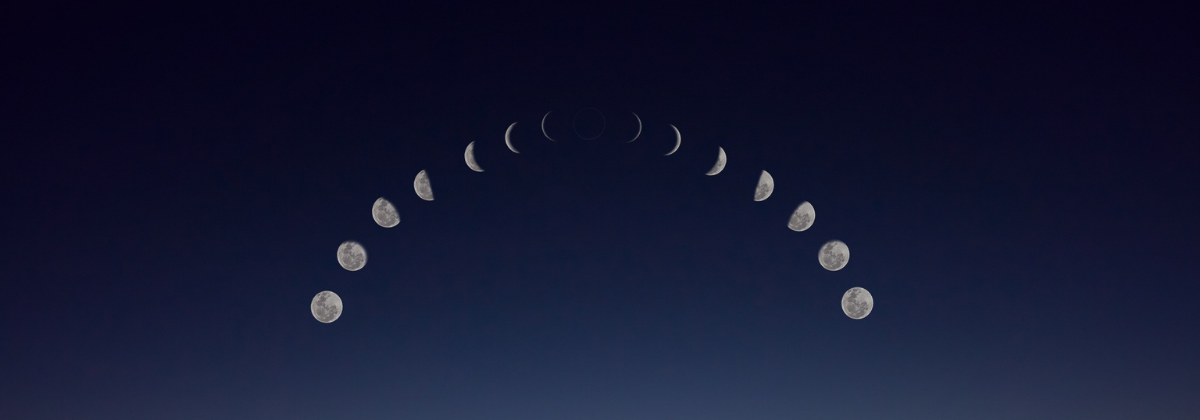
Different traditions divide the Moon's journey differently — some track as few as 2 Phases, others as many as 28. The 8-Phase model is the one most modern astrologers work with, because it captures the clearest turning points without becoming unwieldy. Four of these Phases are the most active — New, First Quarter, Full, and Third Quarter. The other four sit between them, gradually building or releasing light.
New Moon: The Moon sits between the Earth and Sun, its illuminated side facing away from us, so it disappears from view entirely. This is the starting line of the cycle — the sky's version of a blank page.
Waxing Crescent: A sliver of light returns. Small, but visible. The cycle has begun moving, even if the shift is subtle.
First Quarter: Exactly half the Moon is lit. This is the halfway point between darkness and fullness, and astronomically it's when the Sun and Moon sit at a 90-degree angle to each other.
Waxing Gibbous: More than half the Moon is illuminated now, edging closer to full. The shape is almost complete, but not quite.
Full Moon: The Moon and Sun sit in opposition, with the Earth between them, and the Moon's face is fully lit. This is the peak of the cycle — the most visible, most photographed, most talked-about Phase.
Waning Gibbous (Disseminating): The light starts to fall away. Still mostly illuminated, but visibly retreating from its peak.
Third Quarter: The Moon is back to half-lit, but now on the opposite side to the First Quarter. Another 90-degree angle, another turning point — this time heading towards darkness.
Balsamic (Waning Crescent): The final sliver before the Moon disappears again. The quietest part of the cycle, right before it resets.
Why the Moon cycle matters in Astrology
Astronomy explains what the Moon is doing. Astrology asks what that pattern might mean for us — and the two aren't in competition, they're just answering different questions.
In Astrology, the Moon represents the emotional body: how we process, how we respond, what we need day to day before we've had the chance to think it through. If the Sun is how you present yourself to the world, the Moon is what's happening underneath that — closer to instinct than image.
That's the modern reading. In Traditional Astrology, the Moon carries a wider brief again — it also speaks to your environment, the flow of events around you, and the physical body itself. Because it moves through the Zodiac Signs faster than any other Planet, it's often called the web weaver: as it passes each one in turn, it picks up their themes and carries them forward, threading the rest of the chart together as it goes.
This link to the physical body isn't only symbolic, either — for centuries, people have noted that the average menstrual cycle sits close to the Moon's own rhythm, at around 28 days. It's a pattern many cultures folded into their understanding of the Moon long before there was a scientific explanation for it.
The Moon changes Sign roughly every two and a half days, so its Phases give us a rhythm we can actually feel over the course of a month, rather than a shift that plays out across years. That's part of why the Moon cycle has held such a steady place in Astrology: it's fast enough to notice, and structured enough to work with.
This is also where the Moon's placement in your Birth Chart comes in. Everyone is born under a particular Phase of the Moon cycle — not just a Sign, but a Phase, based on the exact relationship between the Sun and Moon at the moment you arrived. That's your natal Moon Phase, and it's a different piece of information to your Sun Sign or your Moon Sign. It says less about what you feel and more about how you tend to process what you feel — whether you lead with instinct, need time to build clarity, or find your footing through reflection rather than action.
Working with the cycle of the Moon
You don't need to decipher your Birth Chart to start noticing the Moon cycle. A simple, physical way in is to track what the sky is doing and pair it with something small and concrete — not because the Moon dictates your week, but because having a rhythm to check in against tends to sharpen your own sense of pacing.
New Moon: A natural point to write down what you actually want from the weeks ahead. Keep it specific. Vague intentions are hard to act on; a single clear sentence isn't.
Waxing Crescent: Take the first physical step. Send the email. Book the appointment. Buy the ingredient. Small, but real.
First Quarter: This is where decisions tend to get tested. If something's been sitting half-finished, this is a fair point to either commit to it properly or let it go.
Waxing Gibbous: Refine rather than restart. Look at what's already in motion and adjust the details instead of overhauling the whole plan.
Full Moon: A good marker for noticing what's actually come to fruition, and for being honest about what hasn't. This Phase often gets framed purely as celebration, but it's just as useful for clear-eyed review.
Disseminating (Waning Gibbous): Share what you've learned, or hand something off. This is a natural point for closing a loop rather than opening a new one.
Third Quarter: Clear out what's no longer serving the plan. A cupboard, a commitment, a habit that's outstayed its usefulness.
Balsamic (Waning Crescent): Rest — properly. As preparation: the next New Moon is close, and starting depleted rarely goes well.
Your Natal Moon Phase: The constant in a changing cycle
The Moon cycle repeats every month, but your relationship to it doesn't reset each time. Your natal Moon Phase — the exact Phase the Moon was in when you were born — stays with you for life, shaping how you tend to move through every New Moon, every Full Moon, every version of this cycle that comes around.
Some people are wired to start things (a Waxing Crescent or First Quarter Phase). Others process more slowly, needing the fullness of a situation before they can act on it (Full or Disseminating). Some do their clearest thinking in retreat, closer to the New Moon's darkness than its light. None of these are better than the others — they're just different starting points, and knowing yours changes how you read every Phase that follows.
This is exactly the kind of detail we work through in a Stars & Signs Astrology consultation. Knowing your natal Moon Phase gives you a far clearer picture of how you naturally process, decide, and reset — rather than trying to force yourself into a rhythm that was never built for you in the first place. If you'd like to find out where you began in the cycle, and what that means for the version of it you're living through right now, we'd be glad to talk you through it.